


A Utah lease agreement is a contract between a landlord and a tenant. It defines the terms of the rental, the responsibilities of each party, and the terms that both parties must adhere to.
Typically, landlords use forms and templates to create lease agreements; however, TurboTenant‘s fillable PDF makes the process easier and ensures compliance with state laws.

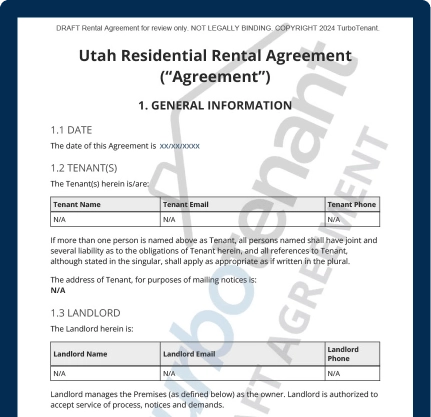
Utah Residential Lease Agreement
Current PageCreate a compliant Utah lease agreement in 15 minutes with TurboTenant's rental contract builder.
Utah Month-to-Month Lease Agreement
Learn MoreBuild your Utah month-to-month lease agreement in 15 minutes.
Required Landlord Disclosures (4)
Landlords review specific information about the rental unit and the rental agreement at the time of lease signing. These disclosures are state or federally mandated. Both parties must sign them according to state law.
- Lead-based paint: Landlords with units built before 1978 must disclose any known information about lead-based paint or lead-based paint hazards upon lease signing. This is the only federally mandated disclosure on this list.
- Methamphetamine: Utah landlords who know that methamphetamine was used, manufactured, or stored on the property must disclose this to the tenant in the lease. The state must also be notified of the contamination (UC § 57-27-201).
- Move-in checklist: Landlords must provide tenants with a written inventory detailing the unit’s condition at the time of move-in, excluding ordinary wear and tear. Additionally, landlords must allow tenants to conduct a walkthrough inspection to document anything not disclosed (UC § 57-22-4(6)(a)).
- Landlord’s name and address: Tenants must be provided with the name, address, and contact information of the landlord or person authorized to manage the property (UC § 57-22-4(7)(a)).
Security Deposit Regulations
Maximum security deposit amount: There are no restrictions on the amount a landlord can charge for security deposits in Utah.
Receipt of deposit: Landlords in Utah are not required to provide tenants with a written receipt of the security deposit.
Deduction tracking: Landlords may use funds from the security deposit for unpaid rent, damages exceeding normal wear and tear, or excessive cleaning. Landlords must provide an itemized receipt for the amounts withheld (UC § 57-17-3(1)).
Returning a tenant’s security deposit: Deposits must be returned within 30 days of the tenant moving out (UC § 57-17-3(2)).
Landlord’s Access to Property
Advance notice: Utah landlords must notify the tenant at least 24 hours’ before entering the property unless otherwise noted in the lease (UC § 57-22-4(2)).
Immediate access: No specific law discusses immediate entry for landlords. It’s commonly accepted that landlords may enter in cases of emergency.
Landlord harassment: Landlords who continually enter a property without notice or cause could be held liable for landlord harassment. Tenants can legally end their lease early and without penalty in such cases.
Rent Payment Laws
Grace period: Utah does not stipulate a mandatory grace period for rent payments, but landlords can include one in the Utah rental contract.
Late rent fees: Late rent fees are capped at $75 or 10% of the monthly rent, whichever is greater, and must be clearly defined in the lease. This is a one-time fee and not an accumulating or daily fee (UC § 57-22-4(5)(a)).
Tenant’s right to withhold rent: Tenants may withhold up to 2 months’ rent for repairing a dangerous or deficient condition if the landlord does not respond or act within 24 hours of receiving notice. Renters must be fully compliant with the lease agreement and must provide copies of the receipts within 5 days after the beginning of the next rental period (UC § 57-22-6(4)(a-b)).
Breach of Rental Agreement
Missed rent payment: After a missed rent payment, Utah landlords can issue a 3-business-day notice to pay or quit (UC § 78B-6-802(1)(c)).
Lease violation: Landlords can issue a 3-calendar-day notice to cure or quit for normal lease violations. For significant or illegal violations, like criminal behavior, landlords can issue a 3-calendar-day notice to quit. It does not give the tenant the option to cure the violation (UC § 78B-6-802(h)), (UC § 78B-6-802(d-g)).
Self-help evictions: Utah landlords should never attempt a self-help eviction by removing tenants on their own. Self-help evictions are illegal in Utah. Landlords should always adhere to the legal eviction process when removing a tenant.
Lease abandonment: Tenants who end their lease early without a qualifying condition could be liable for fees and unpaid rent for the duration of the lease term. Utah landlords must make a reasonable effort to find another tenant to mitigate damages. If a replacement tenant is found, the tenant breaking the lease would only be responsible for the period the unit was vacant (UC § 78B-6-816).
Ending a Lease
Month-to-month: Landlords or tenants wishing to end a month-to-month lease must provide at least 15 days’ written notice to terminate the agreement (UC § 78B-6-802).
Fixed-term: In the state of Utah, tenants are allowed to break their lease legally and without penalty in a few instances. Reasons for legal termination include the tenant entering active military duty, finding the unit uninhabitable, or being harassed by a landlord.
Property abandonment: Landlords may store property left behind for 15 days. They can charge the tenant any inventory, moving, and storage costs. If the tenant pays those costs within 15 days, the landlord may recover the property. If, after 15 days’ notice, the tenant has not retrieved the property, the landlord may dispose of it and attempt to recover disposal costs from the tenant (UC § 78B-6-816(2)).
Renewing a Lease
Required renewals: Utah landlords are not required to renew Utah rental contract when the term expires.
Required notice: Landlords are only required to give 15 days’ written notice to month-to-month tenants if they’re ending the lease. Fixed-term leases do not require notice when the landlord chooses not to renew (UC § 78B-6-802).
Disclaimer: TurboTenant does not provide legal advice. This material has been prepared for informational purposes only. All users are advised to check all applicable local, state, and federal laws and consult legal counsel should questions arise.
Utah Residential Lease Agreement FAQs
Does a landlord have to provide a copy of the lease in Utah?
Utah landlords must provide tenants with a written copy of the lease and any rules and regulations that apply to the rental unit (US § 57-22-4(7)(b)).
What is the grace period for rent in Utah?
There is no state-required grace period for rent in Utah. However, landlords can include one in the lease if they wish.
Can a landlord refuse to renew a lease in Utah?
Yes, landlords in Utah can refuse to renew a rental contract when the term expires.
Does a Utah lease need to be notarized?
Leases in Utah do not need to be notarized. Once both parties sign the document, it is considered legally binding.
Can you withhold rent for repairs in Utah?
Tenants may withhold rent for necessary repairs in Utah if the landlord does not respond to the request within 24 hours. Tenants may withhold up to two month’s rent and must provide an itemized receipt for the cost of the repairs (UC § 57-22-6(4)(a-b)).