


A Virginia lease agreement is a legally binding contract between a landlord and a tenant for a rental property that specifies the parties involved, the property’s address, the rent amount, the lease duration, information about security deposits, policies on contract violations, and more.
To get started, fill in a downloadable residential lease agreement template to protect your rental property. Or stay tuned for a closer look at Virginia lease requirements, required disclosures, landlord obligations, and other rules to know before renting out your property in 2026.

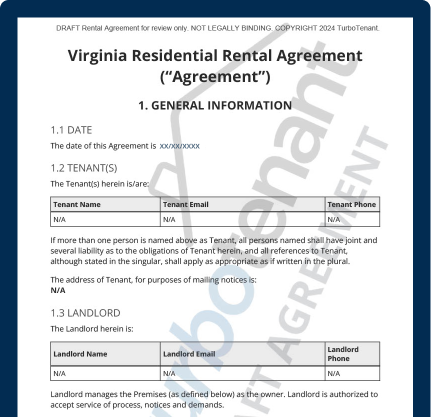
Virginia Residential Lease Agreement
Current PageCreate a compliant Virginia lease agreement in 15 minutes with TurboTenant's rental contract builder.
Virginia Month-to-Month Lease Agreement
Learn MoreBuild your Virginia month-to-month lease agreement in 15 minutes or less.
Room Rental Agreement Virginia
Learn MoreUse a TurboTenant Virginia room rental agreement template to officialize your house hacking operation.
Required Landlord Disclosures (14)
Virginia landlords must disclose specific information about renting property. Here are the required disclosures Virginia landlords must include with the lease agreement:
- Landlord’s name and address: Landlords must disclose the name and address of the property manager and the owner or owner’s authorized agent in writing at or before the beginning of the tenancy (Va. Code Ann. § 55.1-1216).
- Statement of Tenant Rights and Responsibilities: Landlords must provide tenants with the Statement of Tenant Rights and Responsibilities and a copy of the signed rental agreement within 10 business days of the contract’s effective date (Va. Code Ann. § 55.1-1204).
- Move-in checklist: Landlords must provide a move-in inspection report within 5 days of the tenant’s occupancy of the property. The report should itemize any existing property damage and support fair deductions from the security deposit at the end of the lease (Va. Code Ann. § 55.1-1214).
- Fee disclosure statement: The first page of a written rental agreement must itemize all charges that make up the security deposit, periodic rent, and any one-time charges due before the lease starts or with the first rent payment. Immediately above that list, the lease must state: “No additional security deposits or rent shall be charged unless they are listed below or incorporated into this agreement by way of a separate addendum after execution of this rental agreement” (Va. Code Ann. § 55.1-1204.1).
- Lead-based paint: Landlords of homes built before 1978 must inform prospective tenants of known lead-based paint and related hazards before leasing the property. Landlords must also give tenants an EPA-approved pamphlet (42 U.S.C. § 4852d).
- Mold disclosure: Landlords must disclose any visible evidence of mold in readily accessible indoor areas in the move-in inspection report. If landlords disclose visible mold and tenants still choose to take possession, landlords must remediate the mold within 5 business days. If they choose to object to the disclosure, tenants must do so within 5 days after receiving the report (Va. Code Ann. § 55.1-1215).
- Shared utilities: Residential leases must clearly state when landlords use submetering, energy allocation equipment, water or sewer submetering, or a ratio utility billing system to charge tenants for shared utilities (Va. Code Ann. § 55.1-1212).
- Electronic notices: Landlords who want to send notices electronically must include that option in the rental agreement. Tenants may still request paper notices, however (Va. Code Ann. § 55.1-1202).
- Methamphetamine contamination: Landlords must disclose if the rental unit was previously used to manufacture methamphetamine and has not been cleaned in accordance with state guidelines (Va. Code Ann. § 55.1-1219).
- Military air zone: When a rental unit is within a locality with a military air installation, landlords must tell prospective tenants if the property lies within a noise zone, accident potential zone, or both, as shown on the locality’s official zoning map (Va. Code Ann. § 55.1-1217).
- Defective drywall: Landlords must disclose actual knowledge of defective drywall that has not been remediated before the tenant signs a written lease or occupies the unit under an oral lease (Va. Code Ann. § 55.1-1218).
- Demolition or displacement: For multifamily units, landlords must disclose any condominium or cooperative registration filing, or any existing plan, within 6 months of any action that would displace tenants due to demolition, substantial rehabilitation, or conversion to another use (Va. Code Ann. § 55.1-1216).
- Renter’s insurance notice: If the rental agreement does not require renter’s insurance, landlords must give tenants written notice before lease signing that the landlord does not cover the tenant’s personal property, the landlord’s insurance does not cover the tenant’s personal property, and tenants should buy renter’s insurance if they want that protection. The notice must also state that renter’s insurance does not cover flood damage and direct tenants to FEMA or Virginia flood-risk resources for information on special flood hazard areas (Va. Code Ann. § 55.1-1206).
- Landlord-provided insurance summary: If a landlord obtains damage or renter’s insurance for tenants, the landlord must provide each tenant with a summary or certificate of coverage before the tenant signs the rental agreement. Landlords must also notify tenants in writing that they may obtain a separate policy rather than use the landlord’s policy (Va. Code Ann. § 55.1-1206).
Security Deposit Regulations
Maximum security deposit amount: Landlords may charge no more than 2 months’ rent as a security deposit (Va. Code Ann. § 55.1-1226).
Receipt of deposit: Virginia law does not require landlords to provide tenants with a security deposit receipt, though landlords must comply with the state’s requirements for security deposit handling, deductions, and returns (Va. Code Ann. § 55.1-1226).
Deduction tracking: When landlords deduct from a security deposit to cover unpaid rent, damages beyond normal wear and tear, or other lawful charges, they must itemize the withheld amounts in a written notice (Va. Code Ann. § 55.1-1226).
Returning a tenant’s security deposit: Landlords must return the security deposit, minus any lawful deductions, within 45 days after the lease terminates or the tenant vacates the unit, whichever occurs later (Va. Code Ann. § 55.1-1226).
Landlord’s Access to Property
Advance notice: Landlords must give tenants notice before entering the rental unit and may only enter at reasonable times, unless there is an emergency or giving notice is impractical. For routine maintenance not requested by the tenant, landlords must provide at least 72 hours’ notice (Va. Code Ann. § 55.1-1229).
Immediate access: As of 2026, landlords may enter the rental unit without the tenant’s consent in an emergency. If the tenant requests maintenance, the landlord is not legally required to provide advance notice before entering to complete the requested maintenance (Va. Code Ann. § 55.1-1229).
Landlord harassment: Landlords cannot enter unlawfully, enter lawfully in an unreasonable manner, or repeatedly demand entry in a way that unreasonably harasses the tenant. If they do, the tenant may seek injunctive relief, terminate the rental agreement, and recover actual damages and reasonable attorney fees (Va. Code Ann. § 55.1-1210).
Rent Payment Laws
Grace period: Virginia does not require a universal rent grace period when the lease sets its own rent due date or late-payment rules. However, if there is no written rental agreement, rent is due on the 1st day of each month and becomes late if the tenant has not paid by the 5th day. If rent goes unpaid after the grace period, the landlord may serve a 5-Day Notice to Pay or Quit (Va. Code Ann. § 55.1-1204, § 55.1-1245).
Late rent fees: Landlords may charge late fees if permitted by the rental agreement. Late fees may not exceed 10% of the periodic rent or 10% of the unpaid balance, whichever is less. If a rent check or electronic payment is returned for insufficient funds, landlords may charge a processing fee of up to $50 (Va. Code Ann. § § 55.1-1204, 55.1-1200).
Tenant’s right to withhold rent: Tenants can notify the landlord, in writing, of a serious issue that violates the rental agreement or law. If the landlord does not take reasonable steps to fix the issue within 14 days, the tenant can hire a qualified third-party contractor and recover or deduct the cost, up to $1,500 or 1 month’s rent, whichever is greater (Va. Code Ann. § 55.1-1244.1).
Prepaid rent: Virginia landlords and tenants may agree to prepaid rent in the rental agreement. If a landlord receives prepaid rent, the landlord must place it in an escrow account in a federally insured Virginia depository by the end of the 5th business day after receipt and keep it there until the prepaid rent becomes due (Va. Code Ann. § 55.1-1205).
Rent payment processing fees: Virginia landlords cannot charge tenants a fee to collect or process rent, a security deposit, or other fees unless the landlord offers an alternative payment method that does not include additional fees. Landlords should reflect any permitted payment charges clearly in the lease or payment addendum (Va. Code Ann. § 55.1-1204).
Breach of Rental Agreement
Missed rent payment: If tenants do not pay rent by the due date or make an invalid payment, landlords may issue them a 5-Day Notice to Pay or Quit. The lease will continue if tenants pay the rent within the 5-day notice period (Va. Code Ann. § 55.1-1245).
Lease violation: If tenants violate the rental agreement or fail to meet their legal duties in a way that materially affects health and safety, landlords may send a 30-day notice to terminate the lease. If the issue is fixable, the lease will remain valid if the tenant remedies it within 21 days (Va. Code Ann. § 55.1-1245).
Criminal or willful acts: If tenants, authorized occupants, guests, or invitees engage in criminal or willful acts that are not fixable and pose a threat to health or safety, landlords may terminate the rental agreement immediately and proceed to regain possession through the court process (Va. Code Ann. § 55.1-1245).
Self-help evictions: Landlords must use the court process to regain possession of a residential rental unit. If a landlord unlawfully excludes a tenant, interrupts essential services, or makes the premises unsafe, the tenant may seek a court order, actual damages, statutory damages, and reasonable attorney fees (Va. Code Ann. § 55.1-1243.1).
Lease abandonment: If the tenant abandons their belongings before the residential lease ends, the rental agreement may terminate as of the abandonment date. The tenant may still owe rent, actual damages, and reasonable attorney fees, but landlords must mitigate damages by trying to re-rent the unit (Va. Code Ann. § 55.1-1249, § 55.1-1251).
Prohibited lease clauses: Virginia rental agreements cannot require tenants to waive rights or remedies under the Virginia Residential Landlord and Tenant Act, authorize confession of judgment, pay attorney fees except as allowed by law, indemnify the landlord for the landlord’s legal liability, or waive Servicemembers Civil Relief Act rights before a dispute occurs. Virginia law makes prohibited lease terms unenforceable (Va. Code Ann. § 55.1-1208).
Ending a Lease
Month-to-month: To end a month-to-month lease, landlords or tenants must provide the other party with at least 30 days’ written notice before the next rent due date, unless the rental agreement provides a different notice period (Va. Code Ann. § 55.1-1253).
Fixed-term: When tenants break a standard residential rental lease agreement without legal justification, they may owe rent until the landlord re-rents the property or the lease term ends, whichever comes first. Tenants may legally break a lease in some situations, such as military service, family abuse, substantial property damage, or landlord violations (Va. Code Ann. § 55.1-1251).
Property abandonment: Virginia landlords may dispose of abandoned property after issuing proper written notice to the tenant. Depending on the situation, the landlord may need to give a lease termination notice, wait through a 7-day abandonment notice period, or send a separate 10-day notice before disposing of the property (Va. Code Ann. § 55.1-1254).
Renewing a Lease
Required renewals: For leases lasting 1 year or longer, landlords should clearly state whether the agreement renews, ends on a specific date, or converts to a month-to-month tenancy. If the landlord does not provide a written rental agreement, Virginia generally treats the tenancy as lasting 12 months without automatic renewal, except in certain month-to-month situations (Va. Code Ann. § 55.1-1204).
Required notice: Landlords who own more than 4 rental dwelling units, or more than a 10% interest in more than 4 rental dwelling units, must give tenants at least 60 days’ written notice before the lease ends if they want to increase rent during the next lease term or not renew the agreement (Va. Code Ann. § 55.1-1204).
Unsigned or undelivered rental agreement: If one party signs and delivers a written rental agreement but the other party does not, Virginia may still treat the agreement as effective if the landlord accepts rent without reservation, the tenant accepts possession, or the tenant pays rent without reservation. If the agreement has a term longer than 1 year, Virginia limits the effective term to 1 year (Va. Code Ann. § 55.1-1207).
Virginia Residential Lease Agreement FAQs
Does a landlord have to provide a copy of the lease in Virginia?
Yes, Virginia landlords must provide tenants with a copy of the signed written rental agreement, either physical or as a digital PDF, and the statement of tenant rights and responsibilities within 10 business days of the rental agreement’s effective date (Va. Code Ann. § 55.1-1204).
What is the grace period for rent in Virginia?
Virginia does not have a mandatory rent grace period if the lease determines a different due date or late-payment rule. If the landlord does not offer a written rental agreement, however, rent is due on the 1st day of each month and is considered late if not paid by the 5th day (Va. Code Ann. § 55.1-1204).
Can a landlord refuse to renew a lease in Virginia?
Yes. In 2026, landlords who own more than 4 rental dwelling units, or more than a 10% interest in more than 4 rental dwelling units, must give tenants at least 60 days’ written notice before choosing not to renew a rental lease agreement (Va. Code Ann. § 55.1-1204).
Does a Virginia lease need to be notarized?
No, Virginia residential leases do not need to be notarized to be valid.
Can you withhold rent for repairs in Virginia?
Yes, but only in limited situations. Tenants may give written notice of a serious issue and, if the landlord does not take reasonable steps to fix it within 14 days, hire a qualified third-party contractor and deduct the cost from rent, up to $1,500 or 1 month’s rent, whichever is greater (Va. Code Ann. § 55.1-1244.1).
Disclaimer: TurboTenant does not provide legal advice. This material has been prepared for informational purposes only. All users are advised to check all applicable local, state, and federal laws and consult legal counsel should questions arise.