


A Washington, D.C., residential lease agreement establishes the legal framework for the landlord-tenant relationship. It explains key responsibilities, including rent payments, lease term, maintenance duties, property use rules, and what each party can expect during the tenancy.
TurboTenant offers fillable and downloadable lease agreement templates that landlords can use to build a custom contract, but each lease should still reflect the rental property’s terms and local laws. Keep reading for everything you need to know about lease agreements in The District.

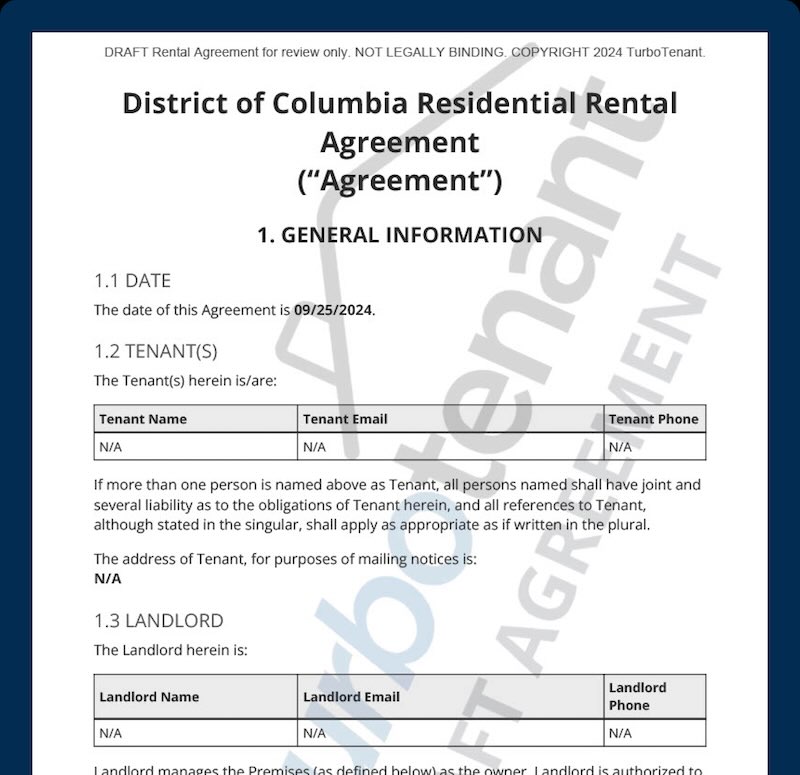
Washington, D.C. Residential Lease Agreement
Current PageCreate a compliant Washington, D.C. residential lease agreement in 15 minutes with TurboTenant's rental contract builder.
Washington, D.C. Month-to-Month Lease Agreement
Learn MoreBuild your Washington, D.C., month-to-month lease agreement in just 15 minutes.
Room Rental Agreement Washington, D.C.
Learn MoreWant to rent out an extra room? Make it official with a Washington, D.C. room rental agreement.
Required Landlord Disclosures (9)
Federal and state laws require landlords to provide certain information about their rental property before signing a Washington, D.C. residential lease agreement. Here’s what you’ll need to disclose to tenants:
- Lead paint: Federal law requires landlords to inform tenants of any known lead-based paint or lead-based hazards on most properties built before 1978 (42 U.S.C. § 4852d).
- Lease and disclosure copies: Washington, D.C., housing providers must provide a copy of the written lease and any required disclosure documents. Tenants may also request, once per calendar year and without charge, copies of the disclosure form and related documents for the rental unit (D.C. Code § 42-3502.22).
- Tenant Bill of Rights: Washington, D.C., housing providers must provide prospective tenants with the Tenant Bill of Rights and the Rent Administrator’s disclosure form when the tenant applies to lease the rental unit (Washington, D.C. Tenant Bill of Rights).
- Voter registration packet: All tenants must receive a voter registration packet with information on voting registration (D.C. Code § 42-3502.22(b)(1B).
- Ownership information: Landlords must disclose the ownership information of the rental unit (D.C. Code § 42-3502.22(b)(1)(J)).
- Mold: Landlords must disclose any knowledge regarding the presence of mold contamination on the rental property within the past 3 years, unless a certified and licensed professional has fully remediated the mold (D.C. Code § 42-3502.22(b)(1)(K)).
- RAD Form 3 (Applicant Disclosure Form): When a prospective tenant applies to lease a rental unit, Washington, D.C., housing providers must provide the Rent Administrator’s disclosure form and related documents. The disclosure must include the applicable rent, pending tenant or housing provider petitions that could affect the unit, rent surcharges, rent increase frequency, rent control or exemption status, business license information, recent housing code or property maintenance violation reports, nonrefundable application fees, security deposit details, condo or co-op status, ownership information, known mold information, the Tenant Bill of Rights, and the voter registration packet (Washington D.C. RAD Form 3).
- Rent control or exemption status: Landlords must inform tenants of the unit’s rent control status at the time of lease signing (D.C. Code § 42-3502.22(b)(1)(E)).
- TOPA exemption notice: If a landlord claims that a rental unit qualifies for certain TOPA exemptions, they must provide the required exemption notice to the tenant or the affected tenant household (D.C. Code § 42-3404.02).
Security Deposit Regulations
Maximum security deposit amount: Washington, D.C. landlords may charge up to 1 month’s rent as a security deposit (14 DCMR § 308.2).
Receipt of deposit: Landlords in Washington, D.C., must provide the tenant with a receipt for the security deposit unless the tenant pays by personal check and clearly states the purpose. The landlord must keep the deposit in a separate, interest-bearing account at a federally insured bank within D.C. (14 DCMR § 308.3).
Location of security deposit account: Landlords must disclose the location of the security deposit account in the lease as well as the amount of the deposit and the current interest rate (D.C. Code § 42-3502.22).
Interest: Landlords must pay interest on security deposits, with the rate adjusted twice during the year — once on January 1 and once on July 1. (14 DCMR § 311.1)
Deduction tracking: Washington, D.C. landlords can withhold funds from the security deposit for any expenses listed in the residential lease agreement, but not for the replacement value of furniture or for damage from normal wear and tear (D.C. Code 42-3502.17(c)).
Returning a tenant’s security deposit: Landlords must return security deposits to the tenant within 45 days of move-out (14 DMCR § 309.1).
Landlord’s Access to Property
Advance notice: Landlords in D.C. must give tenants at least 48 hours’ notice before entering the unit (D.C. Code § 42-3505.51).
Immediate access: Landlords can only enter a rental unit without notice in cases of emergency (D.C. Code § 42-3505.51(b)(1)).
Landlord harassment: Landlords who repeatedly enter a tenant’s unit without proper notice could be liable for landlord harassment. Tenants may be able to obtain a court order barring the landlord from further entry and recovering damages through a lawsuit (D.C. Code § 42-3505.51).
Rent Payment Laws
Grace period: Washington, D.C. requires a minimum grace period of 5 days for late rent payments (D.C. Code § 42-3505.31(b)(2)).
Late-fee lease language: Washington, D.C., landlords may charge a late fee only if the written lease specifies the maximum amount. The fee cannot exceed 5% of the full rent due, and landlords cannot charge it until the tenant fails to pay the full rent within 5 days after the due date or any longer grace period in the lease (D.C. Code § 42-3505.31).
Pet fees and deposits: Landlords may charge a refundable pet security deposit of up to 15% of the monthly rent. Additionally, they can charge 1% of the first month’s rent per dog (1% cumulatively for other pets). Other pet fees are prohibited (D.C. Law 25-308).
Tenant’s right to withhold rent: Washington, D.C., has no laws explicitly allowing a tenant to withhold rent to incentivize their landlord to make necessary repairs.
Breach of Rental Agreement
Missed rent payment: Before filing a nonpayment eviction case, Washington, D.C., landlords must give the tenant at least 10 days’ notice of the landlord’s intent to file a claim to recover possession. Landlords cannot issue this notice if the unpaid rent amount is less than $600 (D.C. Code § 42-3505.01(a-1)(1)).
Lease violation: If a tenant breaches the terms of a rental lease agreement in Washington, D.C., landlords may issue a 30-Day Notice to Cure or Quit, which gives the tenant a chance to resolve the violation (D.C. Code § 42-3505.01(b)).
Self-help evictions: Landlords should never attempt to remove a tenant on their own. Under Washington, D.C. law and across the country, self-help evictions, including removing the tenant’s property or turning off utilities, are illegal.
Lease abandonment: A tenant who breaks a lease early without a legally qualifying condition may be liable for paying rent for the duration of the original lease term, late fees, or other penalties, depending on the specifics of the situation.
Ending a Lease
Month-to-month: A Washington, D.C., tenant may terminate a month-to-month lease by giving the housing provider 30 days’ written notice of the tenant’s intent to vacate. A landlord needs a lawful basis to recover possession rather than a standard month-to-month termination notice (D.C. Code § 42-3505.54, § 42-3505.01).
Fixed-term: Tenants may break a fixed-term lease early, without penalty, only if they meet a legally qualifying condition. These conditions include entering into active military duty, domestic violence, landlord harassment, or uninhabitable living conditions.
Property abandonment: The rules governing how a landlord must handle abandoned personal property depend on the specific reason the tenant left the unit. If the tenant leaves voluntarily and doesn’t take all of their belongings, the law does not specify how landlords should handle the property. For evicted tenants, landlords must store the property for 7 days without charging storage fees. If the tenant does not reclaim the property, the landlord may dispose of it at that time (D.C. Code § 42-3505.01).
Renewing a Lease
Required renewals: Washington, D.C. landlords are not required to offer a new fixed-term lease when the lease term ends. However, lease expiration does not automatically give the landlord the right to recover possession if the tenant keeps paying rent and no lawful eviction ground applies (D.C. Code § 42-3505.01(a)(1)).
Required notice: D.C. landlords do not need to send a separate non-renewal notice only to say they will not offer another fixed-term lease. If the landlord wants the tenant to move out, they must rely on a lawful basis to recover possession rather than the lease end date alone (D.C. Code § 42-3505.01(a)(1)).
Washington, D.C. Residential Lease Agreement FAQs
Does a landlord have to provide a copy of the lease in Washington, D.C.?
Yes. Washington, D.C., landlords must provide tenants with a copy of the residential lease agreement and any other required disclosure documents. Tenants may also request certain rental unit documents once per year without charge (D.C. Code § 42-3502.22).
What is the grace period for rent in Washington, D.C.?
Washington, D.C., requires a 5-day grace period before a landlord can charge a late fee. The late fee must appear in the written lease and cannot exceed 5% of the full rent amount due (D.C. Code § 42-3505.31).
Can a landlord refuse to renew a lease in Washington, D.C.?
Washington, D.C., landlords usually cannot end a tenancy simply because the lease term expires. Tenants generally have the right to continue the tenancy unless the landlord has a legally allowed reason to recover possession of the rental unit (D.C. Code § 42-3505.01).
Does a Washington, D.C. lease need to be notarized?
Washington, D.C., residential leases do not need to be notarized. Once the landlord and tenant sign the lease, the agreement can bind both parties to its terms.
Can you withhold rent for repairs in Washington, D.C.?
Washington, D.C., tenants should not simply stop paying rent for repairs without understanding their legal options. Tenants may have remedies when a landlord fails to maintain the rental unit or violates housing code requirements. Still, they should document the issue, give proper notice, and consider legal guidance before withholding rent.
Disclaimer: TurboTenant does not provide legal advice. This material has been prepared for informational purposes only. All users are advised to check all applicable local, state, and federal laws and consult legal counsel should questions arise.