







Congratulations — you made a profit on your rental property this year! But do you know how rental income is taxed? Part of being a real estate investor is staying up to date on compliance, which means knowing how federal and state tax laws apply to rental income.
In this article, we’ll break down what rental income really is and why tracking income and expenses matters. We’ll explain the rental profit tax rates and show you how to calculate taxes for rental income. You’ll learn about tax deductions for landlords to help you lower your rental profits. Plus, we’ll share a tool to simplify your bookkeeping and tax prep. Let’s get started.
Automate Your Rental Property Accounting
Use our efficient and accurate real estate accounting software to streamline all of your accounting, bookkeeping, and expense tracking needs.
Rental Income Is Taxable
The IRS counts rental income as ordinary income, and you must report all income. Even though rent is usually passive income, it’s taxed at the same rate as your regular wages or salary.
However, under certain circumstances, you may not need to pay tax on rental income. We cover strategies for how landlords pay no taxes on rental income in the linked article.
Rental Income: More Than Just Rent
 Before you can figure out how much tax you owe, you need to calculate your income. So, what counts as rental income?
According to the IRS, rent is a payment for the use or occupation of your property. That covers short- and long-term rentals, plus day-to-day rentals for events — but your income is more than just tenants’ regular rents.
Items counting towards rental income:
- Additional fees: Do you charge late payment fees, pet rent, or fees for amenities like parking or laundry? Those payments are rental income.
- Advance rent payments: If a tenant pays early or provides first and last month’s rent before moving in, the payment counts as reportable income.
- Cancellation or early-termination fees: When a tenant pays to break a lease, you’ll need to include that as rental income.
- Income from renting rooms, buildings, or other spaces: You don’t need to rent out an entire property to have rental income. House hackers who rent a single room, parking space, garage, etc., have reportable rental income.
- Lease with an option to buy: If you lease a property to a tenant who has the option to buy, those payments are still rental income.
- Nonrefundable security deposits: When you keep all or part of a security deposit to cover damages or a violation of the lease terms, the funds count as income. Refundable security deposits do not count as income, though.
- Partial interest: If you don’t own the entire property, you must report your portion of the income from the property. So, if you own 40% of the rental, you’ll report 40% of the rental income on your tax return.
- Prorated rents: If a tenant pays for a partial term, the payment is reportable.
- Regular rents: Tenants may rent by the day, month, week, or year, but these payments are reportable.
- Services in lieu of rent: Sometimes, tenants provide property or services to cover their rent payment. The value of the property or service counts as rental income.
- Tenant-paid owner expenses: A tenant may pay a bill the property owner is responsible for and deduct the amount from their rent payment. Include the deducted amount in your rental income.
- Utility reimbursements: It’s common for property owners to pay utility bills, then have tenants reimburse them. Those reimbursements count as rental income.
Why Tracking Your Rental Income Matters
Tracking your rental income is important because you need to report an accurate figure to the IRS each year. If you underreport your income, you may face IRS audits and penalties, like the Accuracy-Related Penalty. You’ll end up paying a minimum of 20% of the tax due on the understated amount from your tax return, plus interest.
If you only report your monthly rents, you’ll misreport your income — and miscalculate your taxes.
Key point: The IRS may bring criminal charges against you if you commit tax evasion, file false returns, willfully fail to keep records, or intentionally do not pay estimated taxes.
Income Tax Rates for Rental Income
The IRS doesn’t have one set tax percentage on rental income. How much tax you’ll pay on rental income depends on your annual income. That’s because your tax bracket determines which rate applies to you.
For 2025, the IRS has seven tax brackets, ranging from 10% to 37%.
| 2025 Tax rates | Income threshold for single filing status | Income threshold for married filing jointly status |
|---|---|---|
| 10% | $0 to $11,925 | $0 to $23,850 |
| 12% | $11,926 to $48,475 | $23,851 to $96,950 |
| 22% | $48,476 to $103,350 | $96,951 to $206,700 |
| 24% | $103,351 to $197,300 | $206,701 to $394,600 |
| 32% | $197,301 to $250,525 | $394,601 to $501,050 |
| 35% | $250,526 to $626,350 | $501,051 to $751,600 |
| 37% | $626,351+ | $751,601+ |
Source: IR-2024-273, Oct. 22, 2024
The IRS adjusts the tax rates and brackets annually to account for inflation. The chart below has the tax rates and thresholds for 2026.
| 2026 Tax rates | Income threshold for single filing status | Income threshold for married filing jointly status |
|---|---|---|
| 10% | $0 to $12,400 | $0 to $24,800 |
| 12% | $12,401 to $50,400 | $24,801 to $100,800 |
| 22% | $50,401 to $105,700 | $100,801 to $211,400 |
| 24% | $105,701 to $201,775 | $211,401 to $403,550 |
| 32% | $201,776 to $256,225 | $403,551 to $512,450 |
| 35% | $256,226 to $640,600 | $512,451 to $768,700 |
| 37% | $640,601+ | $768,701+ |
Source: IR-2025-103, Oct. 9, 2025
Note that these rates do not apply if you file as a corporation, such as an S corp. or a limited liability corporation (LLC).
How to Calculate Income Tax on Rental Profits
Here’s how the income tax rates for rental income work in the real world.
Rental Income Tax Rate Example: Single Filer
Let’s say you have $45,000 in rental income this year. That accounts for all your deductions. The rental income is your only reportable income, and your tax filing status is single. You’d fall into the second bracket, 12%. That means you’ll owe 10% tax on the first $11,925, plus 12% on the remaining income. You’ll owe $5,161.50 on your rental income for this year.
Here’s the formula:
Net rental income × marginal tax rate = tax payable on rental income
$11,925 × 10% = $1,192.50
$33,075 × 12% = $3,969
Tax liability from bracket 1 + tax liability from bracket 2 = total tax payable on rental income
$1,192.50 + $3,969 = $5,161.50
Rental Income Tax Rate Example: Married Filing Jointly
Now, let’s say you have another job with W-2 wages plus the rental income. Your spouse has a job, too, and you file jointly. You and your spouse earned $85,000 combined, and your rental income is $45,000, all after deductions. Your total reportable income is $130,000. You’d fall in the third bracket, 22%.
$23,850 × 10% = $2,385
$ 95,950 × 12% = $11,634
$9,200 × 22% = $2,024
$2,385 + $11,634 + $2,024 = $16,043
Local and State Taxes on Rental Profits
Our examples cover the federal tax brackets and calculations. Depending on where you live and where your rental property is located, you may owe federal, state, and local taxes.
Some states have progressive income tax systems, so depending on your filing status and earnings, the income tax rate for rental income will change. For example, California’s income tax rate starts at 1% and goes up to 13.3%.
But nine states don’t have a state income tax: Alaska, Florida, Nevada, New Hampshire, South Dakota, Tennessee, Texas, Washington, and Wyoming.
Disclaimer: We recommend that you work with a CPA to determine which taxes apply to you and what your tax liability is.
How to Report Rental Income
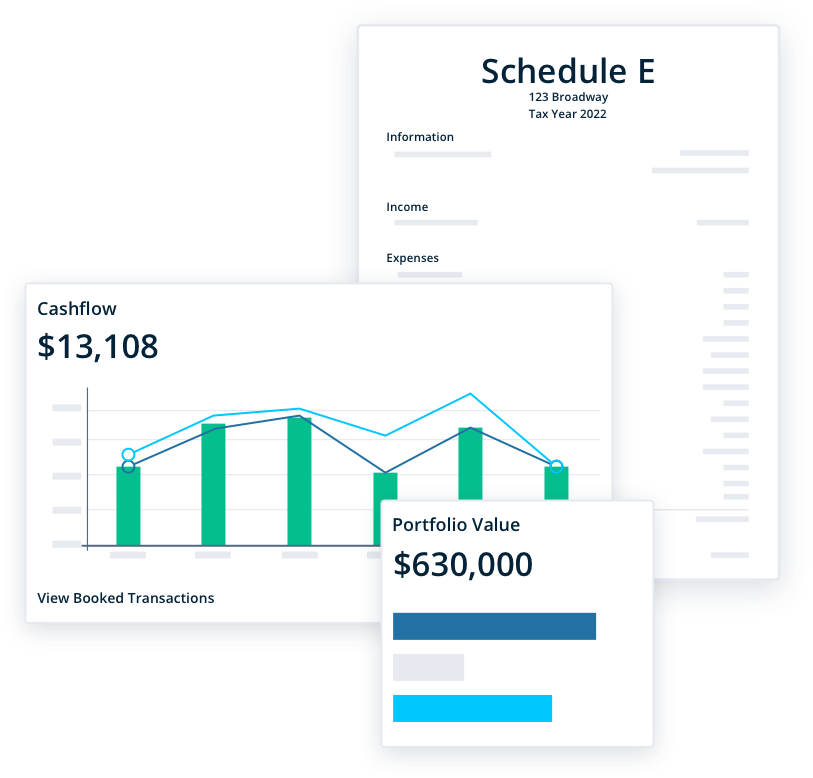
 When it’s time to file your taxes, you’ll complete Form 1040, then attach Schedule E. That’s the form to report rental income and deductible expenses. If you have personal expenses associated with the rental property, some of them may be deductible. You’ll use Schedule A to report those.
Use Form 4562 to report depreciation and property improvements.
Do you qualify for the net investment income tax? If so, you’ll file Form 8960.
Pro tip: If you paid more than $600 to a service provider this year, you may be required to send them a 1099 form. You can learn more about 1099 forms here: “Form 1099 NEC & Independent Contractors.”
Deductible Expenses to Lower Rental Profits
You can deduct necessary and ordinary business expenses from rental income to lower your rental profit tax liability. So, besides tracking your income, you’ll want to track these costs too:
- Advertising and marketing costs, like business cards, website expenses, online listings or ads, and consultant fees
- Auto and travel outlays, with either your actual auto expenses or the standard mileage deduction — not both
- Bank fees
- Cleaning and maintenance expenses
- Condo or homeowners’ association dues
- Depreciation, a major expense that can save you thousands of dollars every year
- Eviction-related costs, including court costs and locksmith fees
- Gifts for clients or tenants
- Home office costs
- Insurance, such as homeowner, flood, or hazard premiums
- Legal and accounting fees, including the cost of accounting or property management software
- Licenses and permits
- Mortgage interest — just the interest, not the principal
- Other interest, like credit card interest or interest paid to nonbank lenders
- Professional development dues, such as association membership fees or business-related education costs
- Property management costs
- Referral fees or leasing commissions
- Repairs
- Service fees from hosting sites, like Vrbo or Airbnb
- Supplies, such as office equipment, printing costs, or small tools
- Taxes, such as property, occupancy, and school district taxes, plus local licensing fees or special easement assessments
- Utilities, including a cell phone or phone line dedicated to your rental business
Tracking your deductible expenses is crucial, but just knowing the numbers isn’t enough. You also need to provide proof of your income and expenses with supporting documentation. That means you’ll need copies of lease agreements, bank deposits, receipts, statements, invoices, and client communications.
Easily Track Rental Profits with TurboTenant
At TurboTenant, we know that accurately tracking your rental income and expenses is critical for calculating your rental profit taxes. That means you need more than a spreadsheet or generic bookkeeping software. You need a robust accounting platform that’s designed specifically for rental property.
That’s where TurboTenant Accounting comes in. Our mission is to simplify bookkeeping for rental property owners like you, so you’re in control of your finances and ready for tax season.
With TurboTenant, you’ll have access to a rental-specific chart of accounts and tools designed for rental property bookkeeping, like templates for mortgage accounting, depreciation calculations, and rule-based transaction matching.
Need to plan and adjust your tax strategies all year long? No problem. Keep tabs on your rental profits with our CPA-approved reports, covering everything from income and cash flow to performance and assets, as well as tax prep and more. Here’s a sample of the built-in reports you can run with TurboTenant Accounting:
- Net Income (Profit and Loss)
- Operating Cash Flow
- Net Operating Income
- Balance Sheet
- Fixed Asset Schedule
- Schedule E
- Form 8825
- Expenses by Vendor
- Security Deposits Held
- Mileage by Property
Even better? Many of our reports are available at the unit, property, and portfolio levels, giving you insight into your finances at every level.
The best way to prepare for tax season and stay compliant is to keep your books organized and accurate with TurboTenant. Sign up for your free account today!
Rental Property Tax FAQs
Can the IRS tell if you have rental income?
Yes, the IRS can tell if you have rental income. They will check for discrepancies in your records, conduct audits and reviews, and review public records. The IRS also receives third-party reports.
How much are rental property taxes?
The tax on rental profits is based on your annual income and IRS tax bracket.
Is rental income reportable?
Yes, rental income is reportable, unless (1) you rent out your property for 14 days or fewer each year and (2) the property counts as your personal residence.
Is rent income taxable?
Yes, the IRS levies income tax on letting property. Check out our comprehensive guide to rental income taxes.
What if you don’t report rental income?
Not reporting income or paying taxes is tax evasion. Failure to report rental income can lead to criminal charges, fines, penalties, and interest.