


An Idaho lease agreement defines the relationship between a landlord and tenant when renting property. Leases set expectations for both parties during the rental term, including rent amount, payment methods, unit policies, deduction protocols, landlord access, and more.
To get started, use TurboTenant to create downloadable PDF lease templates that are compliant with both state and federal laws. With that in mind, all parties involved in an Idaho residential lease agreement should also understand the basics of these ever-important rental lease agreements, starting with disclosures.

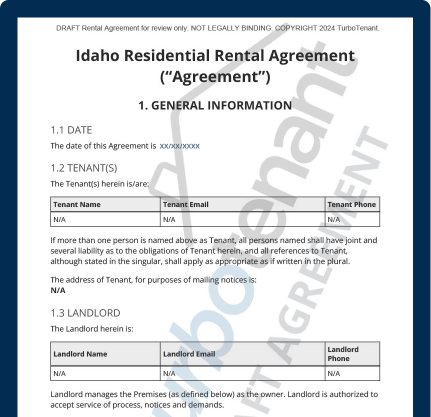
Idaho Residential Lease Agreement
Current PageCreate a compliant Idaho lease agreement in 15 minutes with TurboTenant's rental contract builder.
Idaho Month-to-Month Lease Agreement
Learn MoreCreate your Idaho month-to-month lease agreement in 15 minutes or less.
Room Rental Agreement Idaho
Learn MoreRent your spare room with a Idaho room rental agreement today.
Required Landlord Disclosures (1)
Disclosures are additional information landlords must provide to tenants at or before lease signing. Federal law requires only one disclosure in Idaho, and state law requires no additional disclosures.
- Lead paint: Under federal law, landlords must inform tenants of any known lead-based paint or lead-based paint hazards in any unit built before 1978. Landlords must also provide tenants with the EPA-approved “Protect Your Family from Lead in Your Home” pamphlet (42 U.S.C. § 4852d).
Security Deposit Regulations
Maximum security deposit amount: In Idaho, there is no state-mandated limit on the amount a landlord may charge for a security deposit.
Receipt of deposit: Landlords do not have to give tenants a security deposit receipt. Residential rental premises managed by a third-party manager must maintain security deposits in a separate account at a federally insured financial institution, separate from the third-party agent’s operating account (Idaho Code § 6-321(4)).
Deduction tracking: Landlords may withhold funds from the security deposit only for reasons specified in the rental arrangement. When a landlord returns less than the full deposit, they must provide a signed statement itemizing the amounts lawfully retained, the purpose for each deduction, and a detailed list of expenditures. Landlords may not deduct for normal wear and tear (Idaho Code § 6-321(1), § 6-321(2)).
Returning a tenant’s security deposit: If not otherwise specified in the Idaho residential lease agreement, landlords must return security deposits within 21 days after the tenant surrenders the premises. If the lease sets a different timeframe, it cannot exceed 30 days (Idaho Code § 6-321(2)).
Landlord’s Access to Property
Advance notice: Idaho law does not set a specific advance notice period before a landlord enters a tenant’s unit. However, landlords should provide reasonable notice and generally enter only for legitimate reasons, like inspections, maintenance, repairs, or emergencies.
Immediate access: Landlords in Idaho may enter a unit without prior notice in an emergency.
Landlord harassment: Idaho does not regulate landlord entry or provide a specific ‘unlawful entry’ remedy by statute. A tenant facing repeated or unreasonable intrusion would generally rely on the lease and common-law theories such as breach of the implied covenant of quiet enjoyment or trespass; where a landlord’s conduct breaches a lease term materially affecting health or safety, the tenant may sue for damages and specific performance under § 6-320, and a prevailing party in a Chapter 3 action may recover attorney’s fees under § 6-324.
Rent Payment Laws
Grace period: Idaho has no mandatory grace period for overdue rent payments.
Late rent fees: Idaho does not set a specific statewide cap on late rent fees, though charges should be reasonable and listed in the rental lease agreement to be enforceable.
Rent increase notice: For month-to-month tenancies, a landlord may change other lease terms with at least 15 days’ written notice, but must give at least 30 days’ written notice of a rent increase (or of nonrenewal) on residential property before it takes effect (Idaho Code § 55-307(1)).
Tenant’s right to withhold rent: Unlike many states, Idaho does not allow tenants to withhold rent for repairs or use a general “repair and deduct” remedy. That said, tenants may be able to pursue legal remedies if landlords fail to make necessary repairs under Idaho’s habitability requirements (Idaho Code § 6-320).
Breach of Lease Agreement
Missed rent payment: When a tenant misses a rent payment, Idaho landlords may issue a 3-Day Notice to Pay or Quit (Idaho Code § 6-303(2)).
Lease violation: Idaho landlords can issue a 3-Day Notice to Cure or Quit for most lease violations (Idaho Code § 6-303(3)). But if the tenant commits waste, sublets the unit without permission, or violates a lease condition that cannot be cured, the landlord can issue a 3-Day Notice to Quit without giving the tenant a chance to fix the violation (§ 6-303(4)).
Self-help evictions: Idaho landlords should never attempt self-help evictions by removing a tenant themselves, shutting off utilities, changing locks, or taking the tenant’s belongings. Landlords must always follow the legal eviction process and use a court-issued writ of restitution when removing a tenant from the rental property (Idaho Code § 6-316).
Lease abandonment: Idaho tenants who attempt to break a lease early without a legally valid reason may lose their security deposit, face a civil lawsuit, and remain responsible for unpaid rent or other damages allowed under the lease. Although not required, landlords should also make reasonable efforts to re-rent the unit and mitigate financial losses.
Ending a Lease
Month-to-month: Both landlords and tenants must provide at least 30 days’ written notice to end a month-to-month rental lease agreement in Idaho (Idaho Code § 55-208).
Fixed-term: A tenant may end a fixed-term lease early in limited circumstances: qualifying military service under the federal SCRA (50 U.S.C. § 3955); or, for serious uninhabitable conditions, by pursuing the habitability remedies in § 6-320 (damages and specific performance) and, where conditions make the unit unlivable, common-law constructive eviction. Idaho does not provide a statutory early-termination right for ‘landlord harassment’ or retaliation.
Property abandonment: Idaho does not have a detailed statewide process for abandoned property. However, landlords shouldn’t simply keep, remove, or dispose of a tenant’s belongings without following the legal process. In many cases, landlords may need to seek a court order before removing or selling personal property left in the rental unit.
Renewing a Lease
Required renewals: Idaho landlords do not have to renew a tenant’s Idaho residential lease agreement when the lease term ends. Under state and federal law, though, landlords cannot refuse to renew a lease for discriminatory or retaliatory reasons.
Required notice: Idaho landlords must provide at least 30 days’ written notice when they want to end a month-to-month lease (Idaho Code § 55-208). Landlords should also give tenants at least 30 days’ written notice of their intent not to renew the tenant’s lease.
Idaho Residential Lease Agreement FAQs
Does a landlord have to provide a copy of the lease in Idaho?
No, Idaho law does not require landlords to provide tenants with a copy of a standard residential lease agreement. That said, providing a signed copy to each party is a best practice that helps avoid disputes over agreed-upon terms.
What is the grace period for rent in Idaho?
Idaho does not require a statewide grace period for late rent payments. Unless the lease provides otherwise, landlords may enforce late rent rules as outlined in the rental agreement. Any late fees must be reasonable and clearly stated in the lease to be enforceable.
Can a landlord refuse to renew a lease in Idaho?
Yes. For standard fixed-term leases, Idaho landlords are not obligated to renew the lease once the term expires. A fixed-term lease does not automatically extend once it ends unless both parties agree. Landlords cannot refuse renewal for discriminatory or retaliatory reasons, however, under state and federal law.
Does an Idaho lease need to be notarized?
No, Idaho leases do not need notarization to be legally valid. A written, signed lease can establish the agreed-upon terms between the landlord and tenant.
Can you withhold rent for repairs in Idaho?
No, Idaho tenants cannot withhold rent or use a general “repair and deduct” remedy for habitability issues. The one exception involves smoke detectors: after giving the landlord 3 days’ written notice, a tenant may install necessary smoke detectors and deduct the cost from the next month’s rent. For all other habitability issues, tenants must give the landlord written notice of the problem and can file suit to compel repairs if the landlord fails to act within 3 days (Idaho Code § 6-320).
Disclaimer: TurboTenant does not provide legal advice. This material has been prepared for informational purposes only. All users are advised to check all applicable local, state, and federal laws and consult legal counsel should questions arise.